« Mortad » : la mort pour qui quitte l’islam, preuve par la loi de la République islamique
Ertedâd · ارتداد · Apostasy
« Mortad » : la mort pour qui quitte l’islam, preuve par la loi de la République islamique
Le Code pénal du régime ne prononce jamais le mot « apostasie ». Il n’en a pas besoin. Démonstration en quatre textes, et par les faits.
“Mortad”: death for leaving Islam, proven by the Islamic Republic’s own law
The regime’s Penal Code never says the word “apostasy”. It does not need to. A proof in four texts, and in facts.
«مرتد»: مرگ برای خروج از اسلام، به حکم قانون خودِ جمهوری اسلامی
قانون مجازات این رژیم هرگز واژهٔ «ارتداد» را بر زبان نمیآورد. نیازی هم ندارد. اثبات در چهار متن، و با واقعیتها.
En persan, deux mots suffisent à condamner un homme. Ertedâd (ارتداد) : l’apostasie, le fait de quitter l’islam. Mortad (مرتد) : l’apostat, celui qui l’a quitté.
Face aux Occidentaux, les défenseurs de la République islamique ont une réponse toute prête : « Ouvrez notre Code pénal. Cherchez le mot ertedâd. Vous ne le trouverez pas. Aucune loi iranienne ne punit l’apostasie. »
Ils disent vrai sur un point : le mot n’y est pas. Ils mentent sur tout le reste. Car la peine, elle, y est. Nous allons le démontrer, texte après texte, comme on démontre un théorème : sans adjectif, sans interprétation, avec les articles eux-mêmes.
Texte 1 : le Code pénal renvoie ailleurs
Le Code pénal islamique de 2013 (qânoun-e mojâzât-e eslâmi, adopté en 1392 du calendrier iranien) énumère les peines fixes de la charia, les hadd : fornication, sodomie, consommation d’alcool, vol, « guerre contre Dieu »… L’apostasie n’est pas dans la liste. Mais la liste se termine par une porte.
Article 220 du Code pénal islamique
« در مورد حدودی که در این قانون ذکر نشده است طبق اصل یکصد و شصت و هفتم (۱۶۷) قانون اساسی جمهوری اسلامی ایران عمل میشود. »
« Pour les peines hadd qui ne sont pas mentionnées dans la présente loi, il est procédé conformément à l’article 167 de la Constitution de la République islamique d’Iran. »
Autrement dit : le Code avoue lui-même qu’il existe des peines hadd qu’il n’a pas écrites, et il ordonne de les appliquer quand même.
Texte 2 : la Constitution ordonne de juger selon les fatwas
Où mène la porte de l’article 220 ? À l’article 167 de la Constitution :
« قاضی موظف است کوشش کند حکم هر دعوا را در قوانین مدونه بیابد و اگر نیابد با استناد به منابع معتبر اسلامی یا فتاوای معتبر، حکم قضیه را صادر نماید و نمیتواند به بهانه سکوت یا نقص یا اجمال یا تعارض قوانین مدونه از رسیدگی به دعوا و صدور حکم امتناع ورزد. »
« Le juge est tenu de s’efforcer de trouver la règle de chaque affaire dans les lois codifiées ; s’il ne la trouve pas, il rend son jugement en s’appuyant sur les sources islamiques de référence ou sur des fatwas valides, et il ne peut refuser de juger sous prétexte du silence, de l’insuffisance, de l’imprécision ou de la contradiction des lois codifiées. »
Le silence de la loi n’est donc pas une protection. Il est, par la Constitution elle-même, interdit au juge de s’en servir. Là où le Code se tait, c’est la fatwa qui parle.
Texte 3 : la fatwa du fondateur
Quelle fatwa ? Dans la République islamique, la référence juridique par excellence est le recueil de jurisprudence du fondateur du régime, Rouhollah Khomeini : le Tahrir al-Wassila. C’est à lui que la Cour suprême s’est expressément référée pour l’apostasie (voir plus bas l’affaire Nadarkhani).
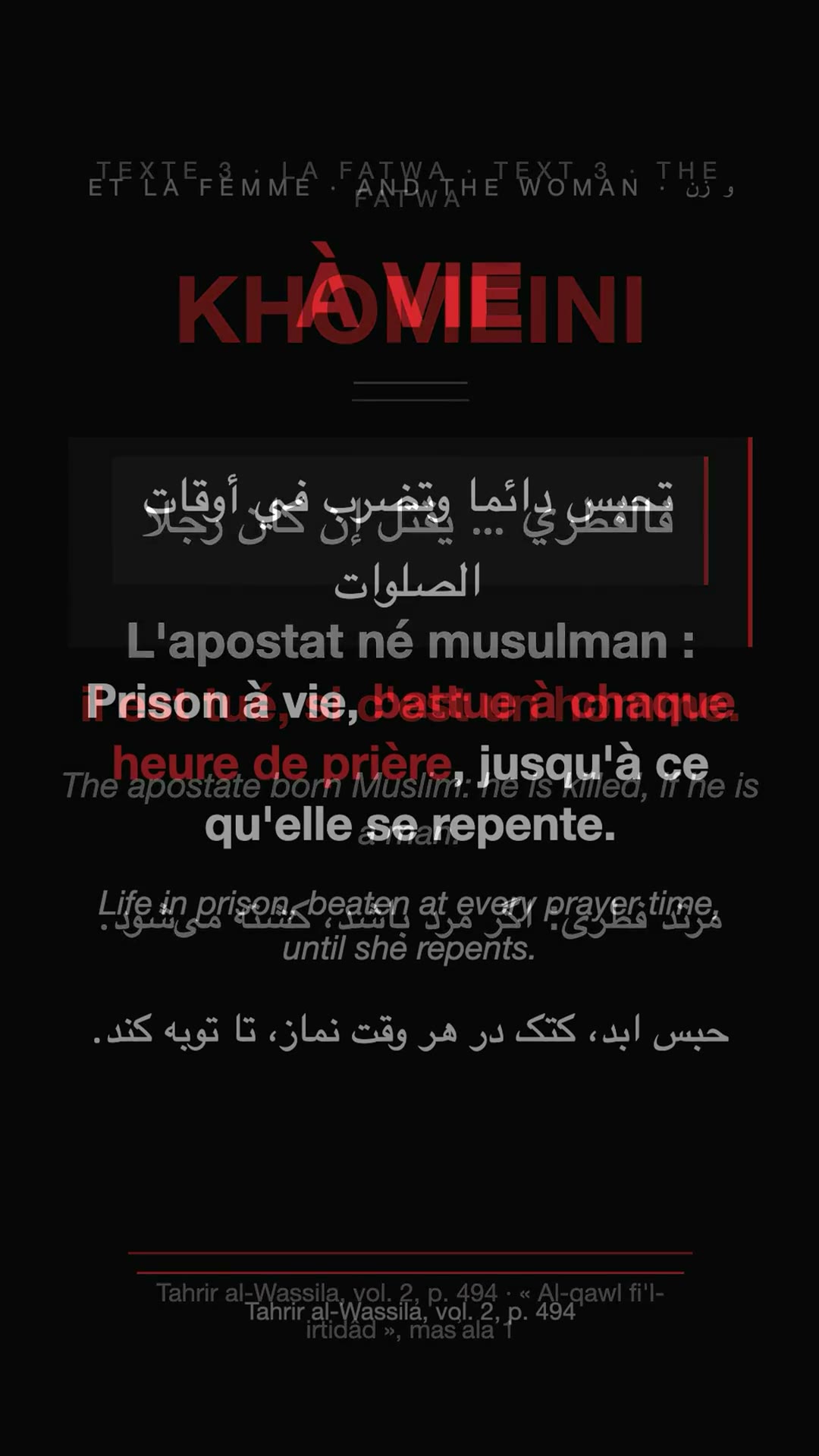
Tome 2, page 494, chapitre « Al-qawl fi’l-irtidâd » (« De l’apostasie »), question n° 1. Voici le texte arabe, mot pour mot :
« فالفطري لا يقبل إسلامه ظاهرا، يقتل إن كان رجلا، ولا تقتل المرأة المرتدة ولو عن فطرة، بل تحبس دائما وتضرب في أوقات الصلوات، ويضيق عليها في المعيشة، وتقبل توبتها، فإن تابت أخرجت عن الحبس. والمرتد الملي يستتاب، فإن امتنع قتل، والأحوط استتابته ثلاثة أيام، وقتله في اليوم الرابع. »
Traduction :
« L’apostat de naissance (fitri, né d’un parent musulman) : son retour à l’islam n’est pas accepté ; il est tué s’il est un homme. La femme apostate n’est pas tuée, même si elle est née musulmane : elle est emprisonnée à perpétuité, frappée aux heures des prières, on lui rend la vie étroite ; son repentir est accepté, et si elle se repent, on la sort de prison. L’apostat national (melli, converti à l’islam puis revenu en arrière) est invité à se repentir ; s’il refuse, il est tué. La précaution est de l’inviter pendant trois jours et de le tuer le quatrième jour. »
Le même chapitre précise, question 4, que l’enfant de musulman qui, à sa majorité religieuse, choisit de ne pas croire, est invité au repentir, « sinon, il est tué ». Et question 9 : l’apostasie se prouve par le témoignage de deux hommes, ou par l’aveu, jamais par le témoignage d’une femme.
Texte 4 : la source de la fatwa
Khomeini n’invente rien. Il applique la tradition chiite. Le recueil de hadiths de référence, al-Kâfi (tome 7, p. 257), repris dans Wasâʾil al-Shîʿa (tome 28, p. 324, « chapitres de la peine de l’apostat »), rapporte cette parole attribuée à l’imam Jaʿfar al-Sâdiq :
« كل مسلم بين مسلمين ارتد عن الإسلام وجحد محمدا نبوته وكذبه فإن دمه مباح لمن سمع ذلك منه، وامرأته بائنة منه يوم ارتد، ويقسم ماله على ورثته، وتعتد امرأته عدة المتوفى عنها زوجها، وعلى الإمام أن يقتله ولا يستتيبه. »
« Tout musulman né de musulmans qui renie l’islam et nie la prophétie de Mohammad : son sang est licite pour quiconque l’entend ; sa femme est séparée de lui le jour même ; ses biens sont partagés entre ses héritiers ; sa femme observe le délai de viduité d’une veuve ; et l’imam doit le tuer, sans lui offrir le repentir. »
Le vivant est déclaré mort : on partage ses biens, sa femme porte son deuil. Il ne reste plus qu’à accorder le corps au droit.
La tradition sunnite dit la même chose, en trois mots, dans le recueil le plus révéré, Sahîh al-Bukhârî (n° 3017) : « من بدل دينه فاقتلوه » — « Celui qui change de religion, tuez-le. »
Par rigueur : le Coran, lui, promet à l’apostat la colère de Dieu et l’enfer (sourate 2, verset 217), sans fixer de peine terrestre. La mise à mort vient de la Sunna, les paroles attribuées au Prophète et aux imams. Mais dans la République islamique, la Sunna n’est pas une opinion : c’est, par l’article 167, une source du droit.
La démonstration
Mettons les quatre textes bout à bout :
- Le Code pénal ordonne d’appliquer les hadd qu’il n’a pas écrits, selon l’article 167 de la Constitution (art. 220).
- L’article 167 ordonne au juge de juger selon les sources islamiques et les fatwas valides, et lui interdit d’invoquer le silence de la loi (Constitution, art. 167).
- La fatwa de référence du régime fixe la peine de l’apostat : la mort pour l’homme, la prison à vie et les coups pour la femme (Tahrir al-Wassila, II, 494).
- Cette fatwa repose sur la tradition qui déclare son sang licite (al-Kâfi, VII, 257).
Conclusion : dans la loi de la République islamique, la peine de l’apostasie est la mort. Elle n’est pas écrite dans le Code : elle est écrite derrière le Code, à l’endroit exact où le Code renvoie.
Pourquoi le mot a disparu
Ce silence n’est pas un oubli. En 2008, le projet de Code pénal envoyé au Parlement par le pouvoir judiciaire contenait un article 225 consacré à l’apostasie : la mort pour l’homme né musulman, la prison à vie pour la femme, trois jours de repentir pour le converti avant l’exécution. Le texte a provoqué un tollé international. Dans la version définitive de 2013, l’article 225 a disparu.
La peine, elle, est restée : elle est passée par l’article 220. On a effacé le mot pour les ambassades, et gardé la corde pour les Iraniens.
La preuve par les faits
Une loi se juge à ce qu’elle fait. Voici ce que celle-ci a fait.
1988. Pendant le massacre des prisonniers politiques de l’été 1988, une seconde vague, fin août, frappe les prisonniers de gauche, jugés en quelques minutes pour apostasie. Question posée : « Es-tu musulman ? Fais-tu la prière ? » Les hommes nés de familles musulmanes qui refusaient de prier étaient envoyés à la potence. Les femmes recevaient cinq coups de fouet à chaque heure de prière, vingt-cinq par jour, jusqu’à ce qu’elles acceptent de prier (rapport d’enquête du Centre Abdorrahman Boroumand, 2010). Relisez la fatwa : « frappée aux heures des prières ». Ce n’était pas une dérive. C’était le texte, appliqué à la lettre.
1989. Khomeini condamne à mort par fatwa l’écrivain Salman Rushdie, né musulman, pour Les Versets sataniques. Trente-trois ans plus tard, en août 2022, un homme le poignarde sur une scène de l’État de New York. Rushdie y perd un œil.
1990. Le pasteur Hossein Soodmand, converti au christianisme, est pendu à Mashhad le 3 décembre 1990 pour apostasie, sur décision d’un tribunal religieux.
2010. Le pasteur Youcef Nadarkhani, né de parents musulmans, est condamné à mort pour apostasie par un tribunal de la province du Guilan. La Cour suprême se réfère expressément à la jurisprudence de Khomeini : la mécanique des articles 220 et 167, en action. Il faudra une mobilisation mondiale pour qu’il soit finalement acquitté de ce chef, en 2012.
2021. Le régime ajoute au Code un article 500 bis qui punit de prison les activités « déviantes » de « prosélytisme » contraires à « la sainte charia ». Le chrétien converti, le baha’i, le libre-penseur : on n’a plus besoin de prononcer le mot apostasie pour les enfermer.
Ce que cela dit du régime, et de nous
En 2020, une vaste enquête indépendante (GAMAAN, plus de 50 000 répondants) a mesuré ce que les Iraniens croient vraiment. 32 % seulement se disent encore musulmans chiites. Près de la moitié déclarent avoir perdu la religion de leur enfance.
Faites le calcul. Selon la loi de la République islamique, la majorité de la nation iranienne est passible de mort. Voilà ce qu’est ce régime : non pas un gouvernement qui aurait des lois sévères, mais une idéologie qui tient tout un peuple sous une condamnation suspendue.
Il faut se souvenir d’une date. Le 24 juin 1975, l’État impérial d’Iran ratifiait le Pacte international relatif aux droits civils et politiques, dont l’article 18 garantit à chacun la liberté « d’avoir ou d’adopter une religion ou une conviction de son choix ». Sous le Lion et le Soleil, l’Iran signait la liberté de conscience. Sous le turban, il pend ceux qui l’exercent.
L’Iran de demain rendra à chaque Iranien ce que le régime lui a pris : le droit de croire, de ne plus croire, ou de croire autrement, sans qu’aucun juge n’ouvre un livre de fatwas pour décider s’il a le droit de vivre.
Payandeh Iran. Javid Shah.
Sources : Code pénal islamique de 2013, art. 220 ; Constitution de la République islamique, art. 167 (Centre de recherche du Parlement) ; Khomeini, Tahrir al-Wassila, t. 2, p. 494 et p. 495-496 ; al-Kâfi 7:257, repris dans Wasâʾil al-Shîʿa 28:324 ; Sahîh al-Bukhârî n° 3017 ; projet de loi de 2008 : Radio Farda ; 1988 : Centre Abdorrahman Boroumand ; Hossein Soodmand : Article 18 ; Youcef Nadarkhani : Center for Human Rights in Iran ; article 500 bis : Centre de recherche du Parlement ; enquête GAMAAN 2020 : Iran International.
In Persian, two words are enough to condemn a man. Ertedâd (ارتداد): apostasy, the act of leaving Islam. Mortad (مرتد): the apostate, the one who has left.
Faced with Westerners, the Islamic Republic’s defenders have a ready answer: “Open our Penal Code. Look for the word ertedâd. You won’t find it. No Iranian law punishes apostasy.”
On one point they tell the truth: the word is not there. On everything else they lie. Because the punishment is there. We will prove it, text by text, the way one proves a theorem: no adjectives, no interpretation, only the articles themselves.
Text 1: the Penal Code points elsewhere
The 2013 Islamic Penal Code lists the fixed punishments of sharia, the hadd: fornication, sodomy, drinking alcohol, theft, “war against God”… Apostasy is not on the list. But the list ends with a door.
Article 220 of the Islamic Penal Code
« در مورد حدودی که در این قانون ذکر نشده است طبق اصل یکصد و شصت و هفتم (۱۶۷) قانون اساسی جمهوری اسلامی ایران عمل میشود. »
“For hadd punishments not mentioned in this law, action shall be taken in accordance with Article 167 of the Constitution of the Islamic Republic of Iran.”
In other words, the Code itself admits there are hadd punishments it has not written down, and orders them to be applied anyway.
Text 2: the Constitution orders judgment by fatwa
Where does the door of Article 220 lead? To Article 167 of the Constitution:
“The judge is bound to endeavour to find the ruling for each case in the codified laws. If he cannot find it, he shall deliver his judgment on the basis of authoritative Islamic sources or valid fatwas. He may not refuse to hear a case and deliver a judgment on the pretext of the silence, insufficiency, brevity or contradiction of the codified laws.”
The silence of the law is therefore no protection. The Constitution itself forbids the judge from relying on it. Where the Code falls silent, the fatwa speaks.
Text 3: the founder’s fatwa
Which fatwa? In the Islamic Republic, the legal reference par excellence is the jurisprudence of the regime’s founder, Ruhollah Khomeini: the Tahrir al-Wasila. It is the source the Supreme Court explicitly cited on apostasy (see the Nadarkhani case below).
Volume 2, page 494, chapter “Al-qawl fi’l-irtidad” (“On apostasy”), question 1. The Arabic text, word for word:
« فالفطري لا يقبل إسلامه ظاهرا، يقتل إن كان رجلا، ولا تقتل المرأة المرتدة ولو عن فطرة، بل تحبس دائما وتضرب في أوقات الصلوات، ويضيق عليها في المعيشة، وتقبل توبتها، فإن تابت أخرجت عن الحبس. والمرتد الملي يستتاب، فإن امتنع قتل، والأحوط استتابته ثلاثة أيام، وقتله في اليوم الرابع. »
Translation:
“The apostate by birth (fitri, born to a Muslim parent): his return to Islam is not accepted; he is killed if he is a man. The female apostate is not killed, even if born Muslim: she is imprisoned for life and beaten at the times of prayer, and her living is made hard; her repentance is accepted, and if she repents she is released. The national apostate (milli, a convert to Islam who turns back) is asked to repent; if he refuses, he is killed. The cautious course is to ask him for three days and kill him on the fourth.”
The same chapter adds, in question 4, that the child of a Muslim who, on reaching religious majority, chooses unbelief is asked to repent, “otherwise he is killed”. And in question 9: apostasy is proven by the testimony of two men, or by confession, never by the testimony of a woman.
Text 4: the source of the fatwa
Khomeini invents nothing. He applies Shia tradition. The reference hadith collection al-Kafi (vol. 7, p. 257), reproduced in Wasa’il al-Shi’a (vol. 28, p. 324, “chapters on the punishment of the apostate”), reports this saying attributed to Imam Ja’far al-Sadiq:
« كل مسلم بين مسلمين ارتد عن الإسلام وجحد محمدا نبوته وكذبه فإن دمه مباح لمن سمع ذلك منه، وامرأته بائنة منه يوم ارتد، ويقسم ماله على ورثته، وتعتد امرأته عدة المتوفى عنها زوجها، وعلى الإمام أن يقتله ولا يستتيبه. »
“Every Muslim born of Muslims who renounces Islam and denies the prophethood of Muhammad: his blood is lawful to whoever hears it from him; his wife is separated from him that very day; his property is divided among his heirs; his wife observes the waiting period of a widow; and the imam must kill him, without offering him repentance.”
The living man is declared dead: his property is shared out, his wife mourns him. All that remains is to bring the body into line with the law.
Sunni tradition says the same thing, in three words, in its most revered collection, Sahih al-Bukhari (no. 3017): « من بدل دينه فاقتلوه » — “Whoever changes his religion, kill him.”
For the sake of rigour: the Quran itself promises the apostate God’s wrath and hellfire (sura 2, verse 217), without setting an earthly penalty. The killing comes from the Sunna, the sayings attributed to the Prophet and the imams. But in the Islamic Republic the Sunna is not an opinion: through Article 167, it is a source of law.
The proof
Put the four texts end to end:
- The Penal Code orders that unwritten hadd punishments be applied according to Article 167 of the Constitution (Art. 220).
- Article 167 orders the judge to rule by Islamic sources and valid fatwas, and forbids him to invoke the law’s silence (Constitution, Art. 167).
- The regime’s reference fatwa sets the apostate’s punishment: death for the man, life imprisonment and beatings for the woman (Tahrir al-Wasila, II, 494).
- That fatwa rests on the tradition declaring his blood lawful (al-Kafi, VII, 257).
Conclusion: under the law of the Islamic Republic, the punishment for apostasy is death. It is not written in the Code: it is written behind the Code, at the exact place the Code points to.
Why the word disappeared
This silence is no oversight. In 2008, the draft Penal Code sent to Parliament by the judiciary contained an Article 225 devoted to apostasy: death for the man born Muslim, life imprisonment for the woman, three days of repentance for the convert before execution. The text caused an international outcry. In the final 2013 version, Article 225 was gone.
The punishment stayed: it went through Article 220. They erased the word for the embassies, and kept the rope for Iranians.
The proof in facts
A law is judged by what it does. Here is what this one has done.
1988. During the massacre of political prisoners in the summer of 1988, a second wave in late August struck leftist prisoners, tried in minutes for apostasy. The question: “Are you a Muslim? Do you pray?” Men from Muslim families who refused to pray were sent to the gallows. Women received five lashes at every prayer time, twenty-five a day, until they agreed to pray (inquiry report of the Abdorrahman Boroumand Center, 2010). Reread the fatwa: “beaten at the times of prayer”. This was no excess. It was the text, applied to the letter.
1989. Khomeini issues a death fatwa against the writer Salman Rushdie, born Muslim, for The Satanic Verses. Thirty-three years later, in August 2022, a man stabs him on a stage in New York State. Rushdie loses an eye.
1990. Pastor Hossein Soodmand, a convert to Christianity, is hanged in Mashhad on December 3, 1990 for apostasy, by order of a religious court.
2010. Pastor Youcef Nadarkhani, born to Muslim parents, is sentenced to death for apostasy by a court in Gilan province. The Supreme Court explicitly refers to Khomeini’s jurisprudence: the machinery of Articles 220 and 167, at work. It took a worldwide campaign before he was finally acquitted of that charge in 2012.
2021. The regime adds an Article 500 bis to the Code, imprisoning “deviant” “proselytising” activity contrary to “holy sharia”. The Christian convert, the Baha’i, the freethinker: the word apostasy no longer needs to be spoken to lock them up.
What this says about the regime, and about us
In 2020, a large independent survey (GAMAAN, more than 50,000 respondents) measured what Iranians really believe. Only 32% still identify as Shia Muslims. Nearly half say they have lost the religion of their childhood.
Do the arithmetic. Under the law of the Islamic Republic, the majority of the Iranian nation is liable to death. That is what this regime is: not a government with harsh laws, but an ideology holding an entire people under a suspended sentence.
Remember one date. On June 24, 1975, the Imperial State of Iran ratified the International Covenant on Civil and Political Rights, whose Article 18 guarantees everyone the freedom “to have or to adopt a religion or belief of his choice”. Under the Lion and Sun, Iran signed freedom of conscience. Under the turban, it hangs those who exercise it.
Tomorrow’s Iran will give back to every Iranian what the regime took: the right to believe, to stop believing, or to believe differently, without any judge opening a book of fatwas to decide whether they have the right to live.
Payandeh Iran. Javid Shah.
Sources: Islamic Penal Code 2013, Art. 220; Constitution of the Islamic Republic, Art. 167 (Parliament Research Center); Khomeini, Tahrir al-Wasila, vol. 2, p. 494 and pp. 495-496; al-Kafi 7:257, reproduced in Wasa’il al-Shi’a 28:324; Sahih al-Bukhari no. 3017; 2008 bill: Radio Farda; 1988: Abdorrahman Boroumand Center; Hossein Soodmand: Article 18; Youcef Nadarkhani: Center for Human Rights in Iran; Article 500 bis: Parliament Research Center; GAMAAN 2020 survey: Iran International.
در فارسی، دو واژه برای محکوم کردن یک انسان کافی است. ارتداد: خروج از اسلام. مرتد: کسی که از اسلام بیرون رفته است.
مدافعان جمهوری اسلامی در برابر غربیها پاسخی آماده دارند: «قانون مجازات ما را باز کنید. دنبال واژهٔ ارتداد بگردید. پیدایش نمیکنید. هیچ قانونی در ایران ارتداد را مجازات نمیکند.»
در یک نکته راست میگویند: واژه در قانون نیست. در باقی همه دروغ میگویند. چون مجازات در قانون هست. آن را متن به متن اثبات میکنیم، همانگونه که قضیهای ریاضی را اثبات میکنند: بی صفت، بی تفسیر، فقط با خودِ مواد قانون.
متن ۱: قانون مجازات به جای دیگری ارجاع میدهد
قانون مجازات اسلامی مصوب ۱۳۹۲ حدود شرعی را برمیشمارد: زنا، لواط، شرب خمر، سرقت، محاربه… ارتداد در این فهرست نیست. اما فهرست با دری پایان مییابد.
مادهٔ ۲۲۰: «در مورد حدودی که در این قانون ذکر نشده است طبق اصل یکصد و شصت و هفتم (۱۶۷) قانون اساسی جمهوری اسلامی ایران عمل میشود.»
یعنی خودِ قانون اعتراف میکند که حدودی هست که آنها را ننوشته، و دستور میدهد که با این حال اجرا شوند.
متن ۲: قانون اساسی دستور میدهد با فتوا حکم شود
در مادهٔ ۲۲۰ به کجا باز میشود؟ به اصل ۱۶۷ قانون اساسی:
«قاضی موظف است کوشش کند حکم هر دعوا را در قوانین مدونه بیابد و اگر نیابد با استناد به منابع معتبر اسلامی یا فتاوای معتبر، حکم قضیه را صادر نماید و نمیتواند به بهانه سکوت یا نقص یا اجمال یا تعارض قوانین مدونه از رسیدگی به دعوا و صدور حکم امتناع ورزد.»
پس سکوت قانون هیچ پناهی نیست. خودِ قانون اساسی قاضی را از تکیه بر آن منع میکند. آنجا که قانون خاموش است، فتوا سخن میگوید.
متن ۳: فتوای بنیانگذار
کدام فتوا؟ در جمهوری اسلامی، مرجع حقوقی برتر، کتاب فقهی بنیانگذار این رژیم است: روحالله خمینی، «تحریرالوسیله». دیوان عالی کشور در موضوع ارتداد صراحتاً به همین منبع استناد کرده است (پروندهٔ ندرخانی را در ادامه ببینید).
جلد ۲، صفحهٔ ۴۹۴، بخش «القول فی الارتداد»، مسئلهٔ ۱. متن عربی، کلمه به کلمه:
«فالفطري لا يقبل إسلامه ظاهرا، يقتل إن كان رجلا، ولا تقتل المرأة المرتدة ولو عن فطرة، بل تحبس دائما وتضرب في أوقات الصلوات، ويضيق عليها في المعيشة، وتقبل توبتها، فإن تابت أخرجت عن الحبس. والمرتد الملي يستتاب، فإن امتنع قتل، والأحوط استتابته ثلاثة أيام، وقتله في اليوم الرابع.»
ترجمه:
«مرتد فطری (زادهٔ پدر یا مادری مسلمان): اسلامش در ظاهر پذیرفته نمیشود؛ اگر مرد باشد کشته میشود. زن مرتد کشته نمیشود، حتی اگر فطری باشد؛ بلکه برای همیشه زندانی میشود و در اوقات نماز کتک میخورد و در معیشت بر او سخت گرفته میشود؛ توبهاش پذیرفته است و اگر توبه کند از زندان بیرون آورده میشود. مرتد ملی (کسی که مسلمان شده و بازگشته) به توبه فراخوانده میشود؛ اگر نپذیرد کشته میشود. احتیاط آن است که سه روز به توبه فراخوانده شود و روز چهارم کشته شود.»
همین بخش در مسئلهٔ ۴ میافزاید که فرزند مسلمان اگر پس از بلوغ کفر را برگزیند، به توبه فراخوانده میشود، «وگرنه کشته میشود». و در مسئلهٔ ۹: ارتداد با شهادت دو مرد عادل یا با اقرار ثابت میشود، و هرگز با شهادت زنان.
متن ۴: سرچشمهٔ فتوا
خمینی چیزی از خود نساخته است. او سنت شیعی را اجرا میکند. کتاب حدیثی مرجع، «کافی» (جلد ۷، صفحهٔ ۲۵۷)، که در «وسائلالشیعه» (جلد ۲۸، صفحهٔ ۳۲۴، «ابواب حد المرتد») نیز آمده، این سخن را از امام جعفر صادق روایت میکند:
«كل مسلم بين مسلمين ارتد عن الإسلام وجحد محمدا نبوته وكذبه فإن دمه مباح لمن سمع ذلك منه، وامرأته بائنة منه يوم ارتد، ويقسم ماله على ورثته، وتعتد امرأته عدة المتوفى عنها زوجها، وعلى الإمام أن يقتله ولا يستتيبه.»
«هر مسلمانِ زاده از مسلمانان که از اسلام برگردد و نبوت محمد را انکار کند: خونش برای هر کس که این را از او بشنود مباح است؛ همسرش از همان روز از او جدا میشود؛ اموالش میان وارثانش تقسیم میشود؛ همسرش عدهٔ وفات نگه میدارد؛ و بر امام است که او را بکشد و توبهاش را نخواهد.»
انسانِ زنده مرده اعلام میشود: اموالش را تقسیم میکنند، همسرش برایش عزا میگیرد. تنها میماند اینکه جسم را هم با حکم همسو کنند.
سنت سنی نیز همین را، در سه کلمه، در معتبرترین مجموعهاش، «صحیح بخاری» (شمارهٔ ۳۰۱۷) میگوید: «من بدل دينه فاقتلوه»: «هر کس دینش را تغییر دهد، او را بکشید.»
برای دقت: خودِ قرآن برای مرتد خشم خدا و دوزخ را وعده میدهد (سورهٔ بقره، آیهٔ ۲۱۷)، بی آنکه مجازاتی دنیوی تعیین کند. کشتن از سنت میآید، یعنی سخنان منسوب به پیامبر و امامان. اما در جمهوری اسلامی سنت یک نظر نیست: به حکم اصل ۱۶۷، منبع قانون است.
اثبات
چهار متن را کنار هم بگذاریم:
- قانون مجازات دستور میدهد حدودِ نانوشته طبق اصل ۱۶۷ قانون اساسی اجرا شوند (مادهٔ ۲۲۰).
- اصل ۱۶۷ به قاضی دستور میدهد با منابع اسلامی و فتاوای معتبر حکم کند و او را از استناد به سکوت قانون منع میکند (قانون اساسی، اصل ۱۶۷).
- فتوای مرجع این رژیم مجازات مرتد را تعیین میکند: مرگ برای مرد، حبس ابد و کتک برای زن (تحریرالوسیله، ج ۲، ص ۴۹۴).
- این فتوا بر سنتی استوار است که خون او را مباح میداند (کافی، ج ۷، ص ۲۵۷).
نتیجه: در قانون جمهوری اسلامی، مجازات ارتداد مرگ است. در متن قانون نوشته نشده؛ پشتِ قانون نوشته شده، درست همانجا که قانون به آن ارجاع میدهد.
چرا واژه ناپدید شد
این سکوت فراموشی نیست. در سال ۱۳۸۷، لایحهٔ قانون مجازات که قوهٔ قضاییه به مجلس فرستاد مادهٔ ۲۲۵ را به ارتداد اختصاص داده بود: اعدام برای مرد مرتد فطری، حبس ابد برای زن، سه روز مهلت توبه برای مرتد ملی پیش از اعدام. این متن اعتراض جهانی برانگیخت. در متن نهایی ۱۳۹۲، مادهٔ ۲۲۵ دیگر نبود.
اما مجازات ماند: از راه مادهٔ ۲۲۰. واژه را برای سفارتخانهها پاک کردند و طناب را برای ایرانیان نگه داشتند.
اثبات با واقعیتها
قانون را با کارنامهاش میسنجند. این کارنامهٔ این قانون است.
۱۳۶۷. در کشتار زندانیان سیاسی تابستان ۱۳۶۷، موج دوم، در اوایل شهریور، زندانیان چپ را هدف گرفت که در چند دقیقه به اتهام ارتداد محاکمه شدند. پرسش این بود: «مسلمانی؟ نماز میخوانی؟» مردانِ زاده از خانوادههای مسلمان که از نماز سر باز میزدند به چوبهٔ دار سپرده شدند. زنان در هر وقت نماز پنج ضربه شلاق میخوردند، روزی بیستوپنج ضربه، تا نماز خواندن را بپذیرند (گزارش تحقیقی مرکز اسناد حقوق بشر عبدالرحمن برومند، ۲۰۱۰). فتوا را دوباره بخوانید: «در اوقات نماز کتک میخورد». این انحراف نبود. این خودِ متن بود، مو به مو.
۱۳۶۷ (فوریهٔ ۱۹۸۹). خمینی با فتوایی سلمان رشدی، نویسندهٔ مسلمانزاده، را بهخاطر «آیات شیطانی» به مرگ محکوم کرد. سیوسه سال بعد، در اوت ۲۰۲۲، مردی در ایالت نیویورک روی صحنه به او چاقو زد. رشدی یک چشمش را از دست داد.
۱۳۶۹. کشیش حسین سودمند، نوکیش مسیحی، در ۱۲ آذر ۱۳۶۹ (۳ دسامبر ۱۹۹۰) در مشهد به حکم دادگاه شرع به اتهام ارتداد به دار آویخته شد.
۱۳۸۹. کشیش یوسف ندرخانی، زادهٔ پدر و مادری مسلمان، از سوی دادگاهی در گیلان به اتهام ارتداد به اعدام محکوم شد. دیوان عالی کشور صراحتاً به فقه خمینی استناد کرد: سازوکار مادهٔ ۲۲۰ و اصل ۱۶۷ در عمل. یک کارزار جهانی لازم بود تا سرانجام در ۱۳۹۱ از این اتهام تبرئه شود.
۱۳۹۹. رژیم مادهٔ ۵۰۰ مکرر را به قانون افزود که فعالیت «آموزشی یا تبلیغی انحرافی» مغایر با «شرع مقدس» را با زندان مجازات میکند. نوکیش مسیحی، بهائی، آزاداندیش: دیگر برای به بند کشیدنشان لازم نیست واژهٔ ارتداد را به زبان آورند.
این دربارهٔ رژیم، و دربارهٔ ما، چه میگوید
در سال ۲۰۲۰ (۱۳۹۹)، یک نظرسنجی مستقل گسترده (گمان، با بیش از ۵۰ هزار پاسخدهنده) سنجید که ایرانیان واقعاً به چه باور دارند. تنها ۳۲ درصد هنوز خود را مسلمان شیعه میدانند. نزدیک به نیمی میگویند دینِ کودکیشان را از دست دادهاند.
حساب کنید. به حکم قانون جمهوری اسلامی، بیشترِ ملت ایران در معرض حکم مرگ است. این است این رژیم: نه حکومتی با قوانینی سخت، که ایدئولوژیای که یک ملت را زیر حکمی معلق نگه داشته است.
یک تاریخ را به یاد بیاوریم. در ۳ تیر ۱۳۵۴ (۲۴ ژوئن ۱۹۷۵)، دولت شاهنشاهی ایران میثاق بینالمللی حقوق مدنی و سیاسی را تصویب کرد که مادهٔ ۱۸ آن آزادیِ «داشتن یا پذیرفتن دین یا عقیده به انتخاب خود» را برای هر کس تضمین میکند. زیر شیر و خورشید، ایران آزادی وجدان را امضا کرد. زیر عمامه، کسانی را که از آن بهره میبرند به دار میکشد.
ایرانِ فردا آنچه را این رژیم گرفته به هر ایرانی بازمیگرداند: حق باور داشتن، باور نداشتن، یا دیگرگونه باور داشتن، بی آنکه هیچ قاضیای کتاب فتوایی باز کند تا تصمیم بگیرد که او حق زندگی دارد یا نه.
پاینده ایران. جاوید شاه.
منابع: قانون مجازات اسلامی ۱۳۹۲، مادهٔ ۲۲۰؛ قانون اساسی، اصل ۱۶۷ (مرکز پژوهشهای مجلس)؛ خمینی، تحریرالوسیله، ج ۲، ص ۴۹۴ و ص ۴۹۵ تا ۴۹۶؛ کافی ۷:۲۵۷، در وسائلالشیعه ۲۸:۳۲۴؛ صحیح بخاری، ش ۳۰۱۷؛ لایحهٔ ۱۳۸۷: رادیو فردا؛ ۱۳۶۷: مرکز عبدالرحمن برومند؛ حسین سودمند: مادهٔ ۱۸؛ یوسف ندرخانی: مرکز حقوق بشر در ایران؛ مادهٔ ۵۰۰ مکرر: مرکز پژوهشهای مجلس؛ نظرسنجی گمان ۲۰۲۰: ایران اینترنشنال.