« Lavât » : l’épée, le feu ou le précipice, ce que la loi de la République islamique réserve aux homosexuels
Lavât · لواط · Code pénal islamique, art. 233-240
« Lavât » : l’épée, le feu ou le précipice, ce que la loi de la République islamique réserve aux homosexuels
Ici, pas besoin de démonstration cachée : le Code pénal l’écrit en toutes lettres. Et la fatwa du fondateur précise la manière de tuer.
“Lavat”: the sword, the fire or the cliff, what the Islamic Republic’s law reserves for homosexuals
No hidden proof needed here: the Penal Code spells it out. And the founder’s fatwa specifies how to kill.
«لواط»: شمشیر، آتش یا پرتگاه؛ آنچه قانون جمهوری اسلامی برای همجنسگرایان در نظر گرفته است
اینجا نیازی به اثبات پنهان نیست: قانون مجازات آن را صریح نوشته است. و فتوای بنیانگذار شیوهٔ کشتن را هم مشخص کرده است.
Pour l’apostasie, le régime cache la peine derrière un renvoi. Pour l’homosexualité, il ne cache rien. Le Code pénal islamique de 2013 y consacre un chapitre entier, articles 233 à 240, sous le titre « Lavât, tafkhiz et mosâheqeh ». Trois mots de la charia pour désigner trois façons d’aimer quelqu’un du même sexe, et une échelle de peines qui va du fouet à la mort.
Voici les textes. Rien que les textes.
Ce que dit le Code pénal
Article 233. Le lavât est défini comme la pénétration d’un homme par un homme.
Article 234 du Code pénal islamique
« حد لواط برای فاعل، درصورت عنف، اکراه یا دارا بودن شرایط احصان، اعدام و در غیر این صورت صد ضربه شلاق است. حد لواط برای مفعول در هر صورت (وجود یا عدم احصان) اعدام است. »
« La peine du lavât pour le partenaire actif est la mort s’il y a eu violence, contrainte, ou s’il est marié ; sinon, cent coups de fouet. La peine pour le partenaire passif est la mort, dans tous les cas, marié ou non. »
Lisez bien la dernière phrase. Deux hommes adultes, consentants, célibataires : l’un reçoit cent coups de fouet, l’autre est exécuté. Et la note 1 ajoute : si l’actif n’est pas musulman et le passif l’est, l’actif est exécuté aussi.
Articles 235 et 236. Sans pénétration (tafkhiz) : cent coups de fouet pour chacun des deux, sans distinction.
Article 237. Tout autre geste entre hommes « par désir », un baiser, une caresse : 31 à 74 coups de fouet. Une note étend la règle aux femmes.
Articles 238 à 240. Entre femmes (mosâheqeh) : cent coups de fouet, sans distinction entre musulmane ou non, mariée ou non, consentante ou non.
Article 136. Celui ou celle à qui une peine hadd a été appliquée trois fois est, la quatrième fois, mis à mort. La femme qui aime une femme est donc fouettée trois fois, puis exécutée.
Comment on prouve, et comment on s’en passe
Le Code exige, pour prouver ces « crimes », quatre aveux (article 172) ou le témoignage de quatre hommes (article 199). Le témoignage des femmes n’est pas reçu.
Les défenseurs du régime aiment ce détail : « Quatre témoins oculaires, c’est impossible à réunir : la loi ne s’applique jamais. » C’est oublier l’article 211 : le « savoir du juge » (elm-e qâzi). Le juge peut condamner sur sa seule conviction, tirée d’indices, de rapports de police, d’expertises, d’aveux obtenus en détention. Les quatre témoins sont la vitrine ; le savoir du juge est la porte de derrière.
Ce que dit la fatwa du fondateur
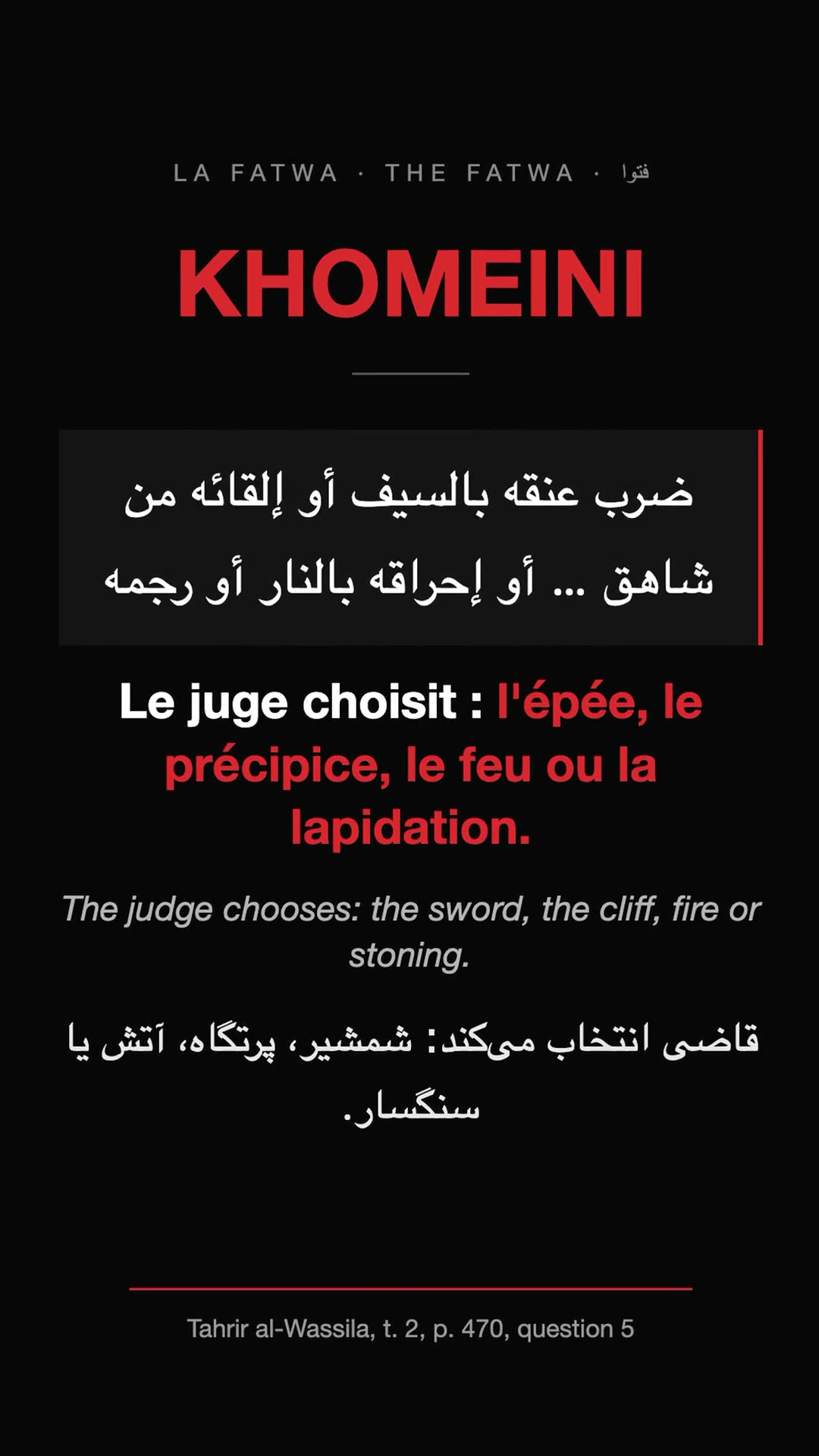
Le Code dit qui meurt. La référence juridique du régime, le Tahrir al-Wassila de Rouhollah Khomeini, dit comment. Tome 2, page 470, chapitre du lavât, question 5, mot pour mot :
« الحاكم مخير في القتل بين ضرب عنقه بالسيف أو إلقائه من شاهق كجبل ونحوه مشدود اليدين والرجلين أو إحراقه بالنار أو رجمه وعلى قول أو إلقاء جدار عليه فاعلا كان أو مفعولا، ويجوز الجمع بين سائر العقوبات والاحراق بأن يقتل ثم يحرق. »
« Le juge a le choix, pour la mise à mort, entre lui trancher le cou à l’épée, le jeter du haut d’un lieu élevé, comme une montagne, pieds et mains liés, le brûler par le feu ou le lapider, ou, selon un avis, faire tomber un mur sur lui, qu’il soit actif ou passif. Il est permis de cumuler ces peines et le feu : le tuer, puis le brûler. »
La page précédente (question 3) pose le principe que le Code reprendra à l’article 211 : « والحاكم يحكم بعلمه », « le juge juge selon son savoir ». Et la question 7 punit deux hommes trouvés nus sous une même couverture, ou celui qui embrasse un garçon « avec désir ». Pour les femmes (questions 9 à 12) : cent coups de fouet, la mort à la quatrième fois, et la punition de deux femmes trouvées nues sous une même couverture.
D’où cela vient
Le Coran raconte la destruction du peuple de Loth, sur lequel Dieu fait tomber « une pluie de pierres » (sourate 7, versets 80 à 84 ; sourate 26, versets 165-166). La peine de mort précise vient de la Sunna : « Celui que vous trouvez commettant l’acte du peuple de Loth, tuez l’actif et le passif » (Abou Dâwoud n° 4462 ; Tirmidhî n° 1456).
Ce n’est pas une dérive d’un juge isolé : c’est la chaîne complète, du livre sacré à la jurisprudence du fondateur, puis au Code pénal voté en 2013.
La preuve par les faits
19 juillet 2005, Mashhad. Deux adolescents sont pendus en public, place Edalat (« place de la Justice »). Le régime parle d’un viol ; les faits restent contestés, et selon plusieurs sources ils étaient mineurs au moment de leur arrestation. Les photos de leurs visages, les yeux bandés, la corde au cou, ont fait le tour du monde.
Farzand e Iran va jan fadayeh mihan
فرزند ایران و جان فدای میهن
Mahmoud Asgari — Baa Sharaf
Ayaz Marhoni — Baa Sharaf
24 septembre 2007, université Columbia, New York. Interrogé sur la peine infligée aux homosexuels, le président Mahmoud Ahmadinejad répond : « En Iran, nous n’avons pas d’homosexuels comme dans votre pays. » La salle éclate de rire. Dans la transcription persane officielle, la phrase sera discrètement retirée.
4 mai 2021, près d’Ahvaz. Alireza Fazeli Monfared, 20 ans, est enlevé et décapité par des hommes de sa propre famille. Ils avaient découvert son orientation grâce à sa carte d’exemption du service militaire : l’État iranien exempte les homosexuels en les classant parmi les « troubles ». C’est un document officiel qui l’a désigné à ses bourreaux.
Farzand e Iran va jan fadayeh mihan
فرزند ایران و جان فدای میهن
Alireza Fazeli Monfared, 20 ans — Baa Sharaf
Septembre 2022, Ourmia. Le tribunal révolutionnaire condamne à mort Zahra « Sareh » Sedighi-Hamadani, 31 ans, et Elham Choubdar, 24 ans, pour « corruption sur terre ». Leur crime : avoir défendu en ligne les personnes LGBT et aidé des jeunes menacés à fuir. Il a fallu une mobilisation internationale pour que la sentence de Sareh soit annulée. Libérée sous caution en mars 2023, elle a fui l’Iran.
Le paradoxe transgenre. Une fatwa de Khomeini, dans les années 1980, autorise le changement de sexe. Le régime s’en sert comme d’une « solution » : des hommes homosexuels sont poussés vers le bistouri pour devenir, aux yeux de la loi, des femmes, et échapper ainsi à l’article 234. La République islamique tolère qu’on change de corps. Elle ne tolère pas qu’on aime.
Ce que cela dit du régime
Aucune de ces lois ne protège personne. Elles ne punissent pas une violence faite à autrui : l’article 234 frappe de mort le consentement lui-même, et l’article 237 fait fouetter un baiser. Elles ne visent qu’une chose : faire entrer l’État islamique dans la chambre de chaque Iranien.
C’est la même logique que le voile imposé, la même que la peine de l’apostat : une idéologie qui veut posséder le corps, la foi et l’amour de chacun. Elle ne s’arrête pas aux homosexuels ; elle commence souvent par eux, parce qu’elle les croit sans défense.
Ils ne le sont pas. Ils sont des enfants de l’Iran, et l’Iran libre ne laissera aucun juge ouvrir un livre de fatwas pour choisir entre l’épée, le feu et le précipice.
Payandeh Iran. Javid Shah.
Sources : Code pénal islamique de 2013, art. 136, 172, 199, 211, 233 à 240 (Centre de recherche du Parlement) ; Khomeini, Tahrir al-Wassila, t. 2, p. 469, p. 470 et p. 471 ; Coran 7:80-84 et 26:165-166 ; Abou Dâwoud n° 4462, Tirmidhî n° 1456 ; Mashhad 2005 : Centre Abdorrahman Boroumand ; Ahmadinejad à Columbia : RFE/RL ; Alireza Fazeli Monfared : IranWire ; Sareh Sedighi-Hamadani et Elham Choubdar : Iran International ; libération de Sareh : IranWire ; fatwa de Khomeini sur le changement de sexe : Maryam Khatoon Molkara, Wikipédia.
For apostasy, the regime hides the punishment behind a cross-reference. For homosexuality, it hides nothing. The 2013 Islamic Penal Code devotes a whole chapter to it, Articles 233 to 240, under the heading “Lavat, tafkhiz and mosaheqeh”. Three sharia words for three ways of loving someone of the same sex, and a scale of punishments running from the lash to death.
Here are the texts. Nothing but the texts.
What the Penal Code says
Article 233. Lavat is defined as the penetration of a man by a man.
Article 234 of the Islamic Penal Code
« حد لواط برای فاعل، درصورت عنف، اکراه یا دارا بودن شرایط احصان، اعدام و در غیر این صورت صد ضربه شلاق است. حد لواط برای مفعول در هر صورت (وجود یا عدم احصان) اعدام است. »
“The punishment of lavat for the active partner is death in case of violence, coercion, or if he is married; otherwise one hundred lashes. The punishment for the passive partner is death in all cases, married or not.”
Read the last sentence again. Two adult men, consenting, unmarried: one receives a hundred lashes, the other is executed. And note 1 adds: if the active partner is not Muslim and the passive one is, the active partner is executed too.
Articles 235 and 236. Without penetration (tafkhiz): one hundred lashes for each, with no distinction.
Article 237. Any other act between men “out of desire”, a kiss, a caress: 31 to 74 lashes. A note extends the rule to women.
Articles 238 to 240. Between women (mosaheqeh): one hundred lashes, with no distinction between Muslim or not, married or not, consenting or not.
Article 136. Anyone on whom a hadd punishment has been carried out three times is, the fourth time, put to death. A woman who loves a woman is therefore flogged three times, then executed.
How it is proven, and how proof is dispensed with
To prove these “crimes” the Code requires four confessions (Article 172) or the testimony of four men (Article 199). Women’s testimony is not accepted.
The regime’s defenders love this detail: “Four eyewitnesses are impossible to gather: the law is never applied.” They forget Article 211: the “knowledge of the judge” (elm-e qazi). The judge may convict on his conviction alone, drawn from circumstantial evidence, police reports, expert opinions, confessions obtained in detention. The four witnesses are the shop window; the judge’s knowledge is the back door.
What the founder’s fatwa says
The Code says who dies. The regime’s legal reference, Ruhollah Khomeini’s Tahrir al-Wasila, says how. Volume 2, page 470, chapter on lavat, question 5, word for word:
« الحاكم مخير في القتل بين ضرب عنقه بالسيف أو إلقائه من شاهق كجبل ونحوه مشدود اليدين والرجلين أو إحراقه بالنار أو رجمه وعلى قول أو إلقاء جدار عليه فاعلا كان أو مفعولا، ويجوز الجمع بين سائر العقوبات والاحراق بأن يقتل ثم يحرق. »
“The judge may choose, for the killing, between striking his neck with the sword, throwing him from a high place such as a mountain, hands and feet bound, burning him with fire or stoning him, or, according to one opinion, bringing a wall down on him, whether he was active or passive. It is permitted to combine these punishments with burning: to kill him, then burn him.”
The previous page (question 3) sets the principle the Code would take up in Article 211: « والحاكم يحكم بعلمه », “the judge rules by his knowledge”. Question 7 punishes two men found naked under one blanket, or a man who kisses a boy “with desire”. For women (questions 9 to 12): one hundred lashes, death the fourth time, and punishment for two women found naked under one blanket.
Where it comes from
The Quran tells of the destruction of the people of Lot, on whom God sends down “a rain of stones” (sura 7, verses 80-84; sura 26, verses 165-166). The precise death penalty comes from the Sunna: “Whoever you find doing the act of the people of Lot, kill the one who does it and the one to whom it is done” (Abu Dawud no. 4462; Tirmidhi no. 1456).
This is not the excess of an isolated judge: it is the complete chain, from the holy book to the founder’s jurisprudence, then to the Penal Code passed in 2013.
The proof in facts
July 19, 2005, Mashhad. Two teenagers are hanged in public, in Edalat (“Justice”) Square. The regime speaks of a rape; the facts remain disputed, and according to several sources they were minors at the time of their arrest. Photos of their faces, blindfolded, the rope around their necks, went around the world.
Farzand e Iran va jan fadayeh mihan
فرزند ایران و جان فدای میهن
Mahmoud Asgari — Baa Sharaf
Ayaz Marhoni — Baa Sharaf
September 24, 2007, Columbia University, New York. Asked about the punishment of homosexuals, President Mahmoud Ahmadinejad answers: “In Iran we don’t have homosexuals like in your country.” The room bursts out laughing. In the official Persian transcript, the sentence is quietly removed.
May 4, 2021, near Ahvaz. Alireza Fazeli Monfared, 20, is abducted and beheaded by men of his own family. They had discovered his orientation through his military service exemption card: the Iranian state exempts homosexuals by classing them as having a “disorder”. An official document pointed him out to his killers.
Farzand e Iran va jan fadayeh mihan
فرزند ایران و جان فدای میهن
Alireza Fazeli Monfared, 20 — Baa Sharaf
September 2022, Urmia. The Revolutionary Court sentences Zahra “Sareh” Sedighi-Hamadani, 31, and Elham Choubdar, 24, to death for “corruption on earth”. Their crime: defending LGBT people online and helping threatened young people flee. It took an international campaign for Sareh’s sentence to be overturned. Released on bail in March 2023, she fled Iran.
The transgender paradox. A fatwa by Khomeini in the 1980s permits sex reassignment. The regime uses it as a “solution”: gay men are pushed under the scalpel to become, in the eyes of the law, women, and so escape Article 234. The Islamic Republic tolerates changing one’s body. It does not tolerate loving.
What this says about the regime
None of these laws protects anyone. They do not punish violence done to another: Article 234 punishes consent itself with death, and Article 237 has a kiss flogged. They aim at one thing only: bringing the Islamic state into every Iranian’s bedroom.
It is the same logic as the compulsory veil, the same as the apostate’s punishment: an ideology that wants to own everyone’s body, faith and love. It does not stop at homosexuals; it often starts with them, because it believes them defenceless.
They are not. They are children of Iran, and a free Iran will let no judge open a book of fatwas to choose between the sword, the fire and the cliff.
Payandeh Iran. Javid Shah.
Sources: Islamic Penal Code 2013, Arts. 136, 172, 199, 211, 233-240 (Parliament Research Center); Khomeini, Tahrir al-Wasila, vol. 2, p. 469, p. 470 and p. 471; Quran 7:80-84 and 26:165-166; Abu Dawud no. 4462, Tirmidhi no. 1456; Mashhad 2005: Abdorrahman Boroumand Center; Ahmadinejad at Columbia: RFE/RL; Alireza Fazeli Monfared: IranWire; Sareh Sedighi-Hamadani and Elham Choubdar: Iran International; Sareh’s release: IranWire; Khomeini’s fatwa on sex reassignment: Maryam Khatoon Molkara, Wikipedia.
در مورد ارتداد، رژیم مجازات را پشت یک ارجاع پنهان میکند. در مورد همجنسگرایی، هیچ چیز را پنهان نمیکند. قانون مجازات اسلامی مصوب ۱۳۹۲ یک فصل کامل، مواد ۲۳۳ تا ۲۴۰، را با عنوان «لواط، تفخیذ و مساحقه» به آن اختصاص داده است. سه واژهٔ شرعی برای سه شیوهٔ دوست داشتنِ یک همجنس، و نردبانی از مجازاتها که از شلاق تا مرگ میرسد.
این متنهاست. فقط متنها.
آنچه قانون مجازات میگوید
مادهٔ ۲۳۳. لواط به دخول مرد در مرد تعریف شده است.
مادهٔ ۲۳۴ قانون مجازات اسلامی
«حد لواط برای فاعل، درصورت عنف، اکراه یا دارا بودن شرایط احصان، اعدام و در غیر این صورت صد ضربه شلاق است. حد لواط برای مفعول در هر صورت (وجود یا عدم احصان) اعدام است.»
جملهٔ آخر را دوباره بخوانید. دو مرد بالغ، با رضایت، مجرد: یکی صد ضربه شلاق میخورد، دیگری اعدام میشود. و تبصرهٔ ۱ میافزاید: اگر فاعل غیرمسلمان و مفعول مسلمان باشد، فاعل نیز اعدام میشود.
مواد ۲۳۵ و ۲۳۶. بدون دخول (تفخیذ): صد ضربه شلاق برای هر دو، بی هیچ تفاوتی.
مادهٔ ۲۳۷. هر رفتار دیگری میان دو مرد «از روی شهوت»، بوسیدن، لمس کردن: ۳۱ تا ۷۴ ضربه شلاق. تبصرهای همین حکم را دربارهٔ زنان نیز جاری میکند.
مواد ۲۳۸ تا ۲۴۰. میان دو زن (مساحقه): صد ضربه شلاق، بی تفاوت میان مسلمان و غیرمسلمان، محصنه و غیرمحصنه، با رضایت یا بی رضایت.
مادهٔ ۱۳۶. هر کس سه بار حدی بر او اجرا شده باشد، بار چهارم اعدام میشود. پس زنی که زنی را دوست دارد، سه بار شلاق میخورد و بار چهارم اعدام میشود.
چگونه اثبات میکنند، و چگونه از اثبات بینیاز میشوند
قانون برای اثبات این «جرمها» چهار بار اقرار (مادهٔ ۱۷۲) یا شهادت چهار مرد (مادهٔ ۱۹۹) را لازم میداند. شهادت زنان پذیرفته نیست.
مدافعان رژیم این جزئیات را دوست دارند: «جمع کردن چهار شاهد عینی ناممکن است؛ این قانون هرگز اجرا نمیشود.» آنان مادهٔ ۲۱۱ را فراموش میکنند: «علم قاضی». قاضی میتواند تنها بر پایهٔ یقین خود حکم دهد؛ یقینی برآمده از قرائن، گزارش پلیس، نظر کارشناس، اعترافی که در بازداشت گرفته شده. چهار شاهد ویترین است؛ علم قاضی درِ پشتی.
آنچه فتوای بنیانگذار میگوید
قانون میگوید چه کسی میمیرد. مرجع حقوقی این رژیم، «تحریرالوسیله»ی روحالله خمینی، میگوید چگونه. جلد ۲، صفحهٔ ۴۷۰، فصل لواط، مسئلهٔ ۵، کلمه به کلمه:
«الحاكم مخير في القتل بين ضرب عنقه بالسيف أو إلقائه من شاهق كجبل ونحوه مشدود اليدين والرجلين أو إحراقه بالنار أو رجمه وعلى قول أو إلقاء جدار عليه فاعلا كان أو مفعولا، ويجوز الجمع بين سائر العقوبات والاحراق بأن يقتل ثم يحرق.»
«حاکم در کشتن مخیر است میان زدن گردن او با شمشیر، پرتاب کردنش از بلندی مانند کوه، با دست و پای بسته، سوزاندنش با آتش یا سنگسار کردنش، یا به قولی فرو ریختن دیواری بر او، چه فاعل باشد چه مفعول. و جایز است میان این مجازاتها و سوزاندن جمع کرد: او را بکشند و سپس بسوزانند.»
صفحهٔ پیش (مسئلهٔ ۳) اصلی را مینهد که قانون در مادهٔ ۲۱۱ برگرفت: «والحاكم يحكم بعلمه»، «حاکم به علم خود حکم میکند». مسئلهٔ ۷ دو مرد برهنه زیر یک پوشش، یا کسی را که پسری را «از روی شهوت» ببوسد، مجازات میکند. برای زنان (مسائل ۹ تا ۱۲): صد ضربه شلاق، مرگ در بار چهارم، و مجازات دو زن برهنه زیر یک پوشش.
از کجا میآید
قرآن نابودی قوم لوط را روایت میکند که خدا بر آنان «بارانی از سنگ» فرو فرستاد (سورهٔ اعراف، آیات ۸۰ تا ۸۴؛ سورهٔ شعرا، آیات ۱۶۵ و ۱۶۶). حکم دقیق مرگ از سنت میآید: «هر کس را یافتید که عمل قوم لوط میکند، فاعل و مفعول را بکشید» (سنن ابوداوود، ش ۴۴۶۲؛ ترمذی، ش ۱۴۵۶).
این انحرافِ یک قاضیِ تنها نیست: زنجیرهٔ کامل است، از کتاب مقدس تا فقه بنیانگذار، و سپس تا قانون مجازات مصوب ۱۳۹۲.
اثبات با واقعیتها
۲۸ تیر ۱۳۸۴، مشهد. دو نوجوان در ملأ عام، در میدان عدالت، به دار آویخته شدند. رژیم از تجاوز سخن گفت؛ واقعیتها همچنان محل تردید است و به گفتهٔ چند منبع، آنان هنگام بازداشت زیر سن قانونی بودند. عکس چهرههایشان، با چشمبند و طناب به گردن، در سراسر جهان دست به دست شد.
Farzand e Iran va jan fadayeh mihan
فرزند ایران و جان فدای میهن
محمود عسگری — با شرف
ایاز مرهونی — با شرف
۲ مهر ۱۳۸۶، دانشگاه کلمبیا، نیویورک. محمود احمدینژاد، در پاسخ به پرسشی دربارهٔ مجازات همجنسگرایان، گفت: «در ایران ما همجنسگرا به شکلی که در کشور شما هست نداریم.» (به نقل از ترجمهٔ انگلیسیِ سخنان او). سالن از خنده منفجر شد. در متن فارسی رسمی، این جمله بیسروصدا حذف شد.
۱۴ اردیبهشت ۱۴۰۰، نزدیک اهواز. علیرضا فاضلی منفرد، ۲۰ ساله، به دست مردانی از خانوادهٔ خودش ربوده و سر بریده شد. آنان از روی کارت معافیت از خدمت سربازیاش به گرایش او پی برده بودند: دولت ایران همجنسگرایان را با عنوان «اختلال» معاف میکند. یک سند رسمی او را به قاتلانش نشان داد.
Farzand e Iran va jan fadayeh mihan
فرزند ایران و جان فدای میهن
علیرضا فاضلی منفرد، ۲۰ ساله — با شرف
شهریور ۱۴۰۱، ارومیه. دادگاه انقلاب زهرا (ساره) صدیقی همدانی، ۳۱ ساله، و الهام چوبدار، ۲۴ ساله، را به اتهام «افساد فیالارض» به اعدام محکوم کرد. جرمشان: دفاع آنلاین از دگرباشان و کمک به فرار جوانانِ در خطر. یک کارزار بینالمللی لازم بود تا حکم ساره نقض شود. او در اسفند ۱۴۰۱ با وثیقه آزاد شد و از ایران گریخت.
تناقض تراجنسیتی. فتوایی از خمینی در دههٔ ۱۳۶۰ تغییر جنسیت را مجاز میداند. رژیم از آن بهعنوان «راهحل» استفاده میکند: مردان همجنسگرا به زیر تیغ جراحی رانده میشوند تا در نگاه قانون زن شوند و از مادهٔ ۲۳۴ بگریزند. جمهوری اسلامی تغییر بدن را تحمل میکند. دوست داشتن را تحمل نمیکند.
این دربارهٔ رژیم چه میگوید
هیچیک از این قوانین از کسی محافظت نمیکند. خشونتی علیه دیگری را مجازات نمیکنند: مادهٔ ۲۳۴ خودِ رضایت را به مرگ محکوم میکند و مادهٔ ۲۳۷ برای یک بوسه شلاق میزند. تنها یک هدف دارند: ورود حکومت اسلامی به اتاق خواب هر ایرانی.
همان منطقِ حجاب اجباری است، همان منطقِ مجازات مرتد: ایدئولوژیای که میخواهد بدن، ایمان و عشق هر کس را از آنِ خود کند. نزد همجنسگرایان متوقف نمیشود؛ اغلب از آنان آغاز میکند، چون گمان میکند بیدفاعاند.
بیدفاع نیستند. آنان فرزندان ایراناند، و ایران آزاد به هیچ قاضیای اجازه نخواهد داد کتاب فتوایی باز کند تا میان شمشیر، آتش و پرتگاه یکی را برگزیند.
پاینده ایران. جاوید شاه.
منابع: قانون مجازات اسلامی ۱۳۹۲، مواد ۱۳۶، ۱۷۲، ۱۹۹، ۲۱۱ و ۲۳۳ تا ۲۴۰ (مرکز پژوهشهای مجلس)؛ خمینی، تحریرالوسیله، ج ۲، ص ۴۶۹، ص ۴۷۰ و ص ۴۷۱؛ قرآن، اعراف ۸۰ تا ۸۴ و شعرا ۱۶۵ و ۱۶۶؛ ابوداوود ش ۴۴۶۲، ترمذی ش ۱۴۵۶؛ مشهد ۱۳۸۴: مرکز عبدالرحمن برومند؛ احمدینژاد در کلمبیا: رادیو اروپای آزاد؛ علیرضا فاضلی منفرد: ایرانوایر؛ ساره صدیقی همدانی و الهام چوبدار: ایران اینترنشنال؛ آزادی ساره: ایرانوایر؛ فتوای خمینی دربارهٔ تغییر جنسیت: مریم خاتون ملکآرا، ویکیپدیا.