Sahand Naseri — l’enfant bakhtiari au Farvahar, tombé sous les balles du régime
جاویدنام · Javid Nâm · Enfant d’Iran
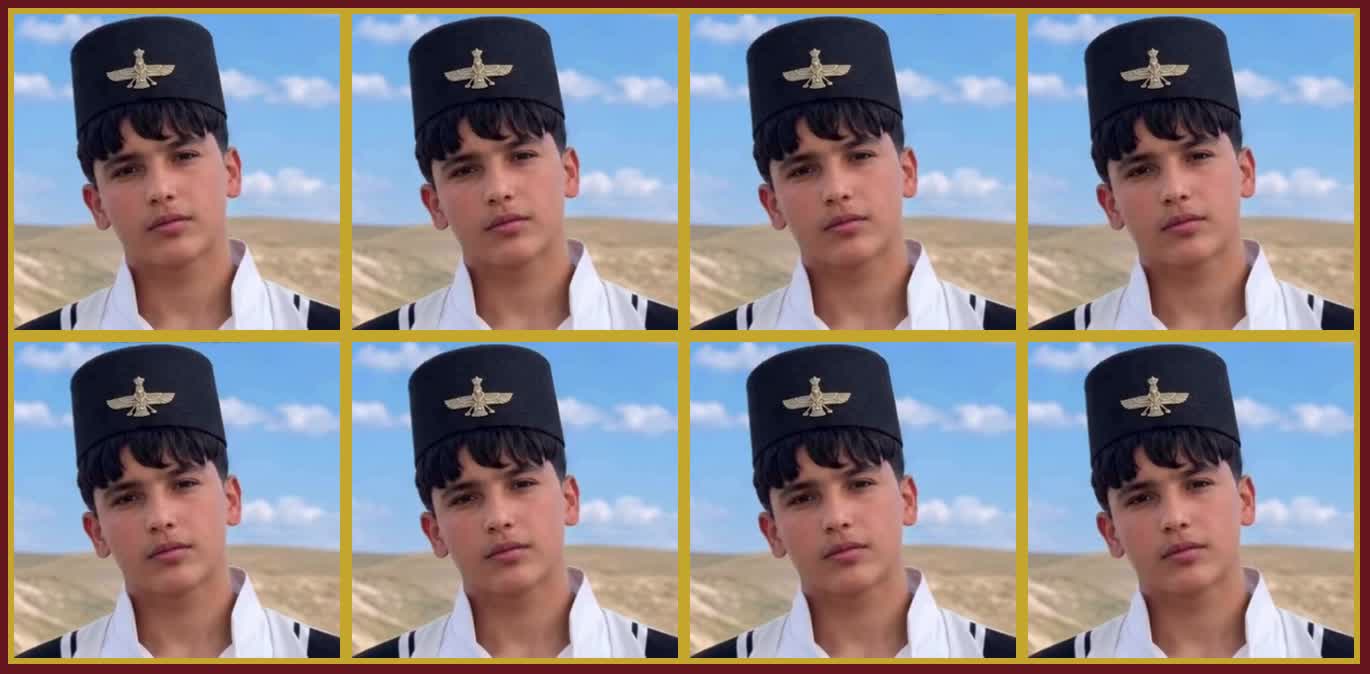
Sahand, l’enfant qui portait l’Iran sur son front
Sahand Naseri, quinze ans, bakhtiari de Shushtar — tombé sous les balles du régime
I · L’enfant au Farvahar
Il s’appelait Sahand. Sahand Naseri. Il avait quinze ans — né au printemps, le 25 avril 2010, à Shushtar, la vieille Tostar des eaux et des ponts, là où le pays bakhtiari descend vers le Khouzistan. Quinze ans : l’âge où l’on rit trop fort, où l’on aime en cachette, où l’on se croit immortel. Il avait mis son plus beau costume, celui de ses pères : la chemise blanche, la chooqa de laine aux rayures noires, et sur la tête le chapeau noir des Bakhtiari, frappé d’un Farvahar d’or. Il s’est tenu droit, face à l’objectif, le ciel de la steppe derrière lui, et il a laissé chanter sa terre.
Le 8 janvier 2026 — le 18 du mois de Dey — à Karaj, dans la grande colère du peuple, les hommes du régime ont visé sa poitrine. Trois balles. Trois balles dans le cœur d’un enfant de quinze ans. C’est cela, leur courage : tirer sur un cœur qui n’avait pas fini de grandir.
Moi qui suis mère, je sais ce qu’est ce silence-là. Le lit qu’on ne défait plus. La porte qu’on guette. Le nom qu’on appelle encore, le soir, par habitude, avant de se souvenir. Sahand n’appellera plus sa mère. Mais sa mère, et toutes les mères d’Iran, l’appelleront jusqu’à la fin.
Car celui qui a fait tirer n’a pas de visage d’homme : il a le visage de Zahaak, le serpent du Shâhnâmeh, le tyran étranger qui ne règne qu’en dévorant la cervelle de la jeunesse. Zahaak, c’est le régime des Mollahs ; et chaque enfant qu’il tue est une bouche de plus offerte aux serpents de ses épaules. Mais le Shâhnâmeh dit aussi la suite : un jour, le forgeron Kâveh lève son tablier comme un étendard, et le peuple enchaîne le monstre pour toujours.
Farzand-e Irân va jân fadâ-ye mihan — enfant d’Iran, offert en sacrifice à la patrie — Sahand Naseri — Bâ Sharaf, avec honneur. Que son nom ne s’éteigne jamais : Javid Nâm.
II · Les Bakhtiari, au cœur de l’iranité
Ne nous arrêtons pas à un seul deuil. Demandons-nous qui sont les Bakhtiari, et pourquoi ce chapeau, et pourquoi ce Farvahar.
Les Bakhtiari sont un peuple lor, et leur langue — le bakhtiari, branche du lori — est une langue iranienne du sud-ouest, sœur charnelle du persan. Mais leur plus belle archive n’est pas dans les livres : elle est dans leur mythe. Car les Bakhtiari racontent qu’ils descendent des jeunes gens qui échappèrent à Zahaak, qui fuirent le tyran-serpent et se réfugièrent dans les neiges du Zard-Kuh. C’est de leur chance d’avoir survécu qu’ils tirèrent leur nom : bakhtiyâr, « les fortunés ». Lisez bien : ce peuple est, dans sa propre légende, l’enfance qui a fui le serpent. Et voilà que le serpent revenu — le régime — abat aujourd’hui l’un de ces enfants. La boucle de quatre mille ans se referme sur le cœur de Sahand.
Patriotes ? Les Bakhtiari l’ont prouvé les armes à la main. En 1909, c’est leur cavalerie qui descendit des montagnes et reprit Téhéran pour rendre au pays sa Constitution arrachée. Au cœur de chaque crise de l’Iran moderne, on retrouve leur fidélité à la nation. Les Bakhtiari ne sont pas un folklore : ils sont une colonne de l’édifice iranien.
Et regardez leur costume, car rien n’y est innocent. La chooqa, ce manteau de laine blanche que tissent les femmes, porte des rayures noires verticales : ce sont, dit la tradition, les colonnes de Persépolis — l’enfant bakhtiari porte sur ses épaules l’architecture des Achéménides. Le chapeau se nomme kolâh-e khosravi, le « chapeau royal », du nom de Khosrow : sur la tête du plus humble berger se pose ainsi la mémoire des rois. Tisser, ici, c’est se souvenir.
Reste le Farvahar, l’homme ailé qui veille au front de Sahand. Il est à l’Iran ce que la croix est à l’Occident : l’emblème d’une civilisation entière, plus vieux que les Achéménides, signe de l’âme qui choisit le bien et veille sur les siens. En 1979, les Mollahs ont chassé le Lion et le Soleil des murs ; mais le Farvahar, le peuple l’a gardé, et l’a fait sien malgré eux.
Alors ne disons surtout pas : « c’était un Bakhtiari ». Disons : c’était un enfant d’Iran. Car ce Farvahar n’appartient pas aux seuls Bakhtiari — il est le blason commun du Perse et du Kurde, du Lor et du Baloutche, de l’Azéri et de l’Arabe, du Turkmène, du Gilak, du Qashqai. Le régime, lui, ne rêve que de nous diviser en tribus dressées les unes contre les autres ; mais sous le même Farvahar, toutes nos langues ne font qu’une seule patrie. Sahand n’est pas le fils des seuls Bakhtiari : il est le fils de tout l’Iran — et son sang est notre sang à tous.
III · Le chant — مر جنگه
Dans la vidéo, Sahand ne dit rien : il laisse chanter sa terre. C’est un chant guerrier des Bakhtiari, de la grande tradition de Masoud Bakhtiari — bâti tout entier sur une seule prière répétée, khodâ doune, « Dieu m’est témoin ». On y nomme le Berno, le vieux fusil tchèque devenu, dans l’épopée lor, l’honneur même de l’homme libre. Voici, du chant entendu derrière son visage, ce que j’ai pu en recueillir et traduire :
Transcription du chant entendu dans la vidéo (lori bakhtiari) ; traduction de Marj. Le lori est un parler ; cette version cherche la fidélité du sens et le souffle, non la lettre.
Sahand, the Child Who Wore Iran Upon His Brow
Sahand Naseri, fifteen years old, a Bakhtiari from Shushtar — fallen to the regime’s bullets
I · The Child of the Farvahar
His name was Sahand. Sahand Naseri. He was fifteen — born in spring, on 25 April 2010, in Shushtar, ancient Tostar of the waters and the bridges, where the Bakhtiari country slopes down toward Khuzestan. Fifteen: the age when one laughs too loudly, loves in secret, and believes oneself immortal. He had put on his finest dress, the dress of his fathers: the white shirt, the woollen chogha with its black stripes, and upon his head the black hat of the Bakhtiari, crowned with a golden Faravahar. He stood straight before the lens, the steppe sky behind him, and let his land sing.
On 8 January 2026 — the 18th of the month of Dey — in Karaj, amid the great anger of the people, the regime’s men aimed at his chest. Three bullets. Three bullets into the heart of a fifteen-year-old child. That is their courage: to fire upon a heart that had not finished growing.
I who am a mother know that silence. The bed left unmade. The watched door. The name still called, at evening, out of habit, before remembering. Sahand will call his mother no more. But his mother — and every mother of Iran — will call him until the end.
For he who gave the order has no human face: he wears the face of Zahaak, the serpent of the Shâhnâmeh, the foreign tyrant who reigns only by devouring the brains of the young. Zahaak is the regime of the Mullahs; and every child he kills is one more mouthful fed to the serpents on his shoulders. But the Shâhnâmeh tells what comes next: one day Kâveh the blacksmith raises his apron like a banner, and the people chain the monster forever.
Farzand-e Irân va jân fadâ-ye mihan — child of Iran, offered in sacrifice to the homeland — Sahand Naseri — Bâ Sharaf, with honour. May his name never fade: Javid Nâm.
II · The Bakhtiari, at the Heart of Iranian-ness
Let us not stop at a single grief. Let us ask who the Bakhtiari are, and why that hat, and why that Faravahar.
The Bakhtiari are a Lur people, and their tongue — Bakhtiari, a branch of Luri — is a Southwestern Iranian language, blood-sister of Persian. But their finest archive is not in books: it is in their myth. For the Bakhtiari say they descend from the young people who escaped Zahaak, who fled the serpent-tyrant and took refuge in the snows of Zard-Kuh. From their luck in surviving they drew their very name: bakhtiyâr, « the fortunate ». Read it well: this people is, in its own legend, the childhood that fled the serpent. And now the returned serpent — the regime — strikes down one of those children. The four-thousand-year circle closes upon Sahand’s heart.
Patriots? The Bakhtiari proved it with weapons in hand. In 1909 it was their cavalry that came down from the mountains and retook Tehran to restore the nation’s stolen Constitution. At the heart of every crisis of modern Iran one finds their loyalty to the nation. The Bakhtiari are not folklore: they are a pillar of the Iranian edifice.
And look at their dress, for nothing in it is innocent. The chogha, that white woollen coat woven by the women, bears vertical black stripes: these are, says tradition, the columns of Persepolis — the Bakhtiari child carries the architecture of the Achaemenids upon his shoulders. The hat is called kolâh-e khosravi, the « royal hat », after Khosrow: upon the head of the humblest shepherd rests the memory of kings. To weave, here, is to remember.
There remains the Faravahar, the winged man who watches at Sahand’s brow. He is to Iran what the cross is to the West: the emblem of a whole civilisation, older than the Achaemenids, sign of the soul that chooses the good and guards its own. In 1979 the Mullahs drove the Lion and the Sun from the walls; but the Faravahar the people kept, and made their own in spite of them.
So let us never say: « he was a Bakhtiari ». Let us say: he was a child of Iran. For that Faravahar belongs not to the Bakhtiari alone — it is the shared coat of arms of the Persian and the Kurd, the Lur and the Baloch, the Azeri and the Arab, the Turkmen, the Gilaki, the Qashqai. The regime dreams only of splitting us into tribes set against one another; but beneath the same Faravahar, all our tongues make a single homeland. Sahand is not the son of the Bakhtiari alone: he is the son of all Iran — and his blood is the blood of us all.
III · The Song — Mar Jange
In the video Sahand says nothing: he lets his land sing. It is a Bakhtiari war-song, of the great tradition of Masoud Bakhtiari — built wholly upon a single repeated prayer, khodâ doune, « God is my witness ». It names the Berno, the old Czech rifle that became, in the Lur epic, the very honour of the free man. Here, from the song heard behind his face, is what I could gather and translate:
Transcription of the song heard in the video (Bakhtiari Luri); translation by Marj. Luri is a spoken dialect; this rendering seeks faithfulness of meaning and breath, not the letter.
سهند، کودکی که ایران را بر پیشانی داشت
سهند ناصری، پانزدهساله، بختیاریِ شوشتر — به دست گلولههای رژیم
۱ · کودکِ فروهر
نامش سهند بود. سهند ناصری. پانزده ساله بود — زادهٔ بهار، پنجمِ اردیبهشتِ ۱۳۸۹، در شوشتر، همان تُسترِ کهنِ آبها و پلها، آنجا که سرزمینِ بختیاری به سوی خوزستان فرود میآید. پانزدهسالگی: سنِ بلند خندیدن، پنهان عاشقشدن، و خود را جاودانه پنداشتن. زیباترین جامهاش را پوشیده بود، جامهٔ پدرانش را: پیراهنِ سپید، چوقای پشمی با راهراههای سیاه، و بر سر کلاهِ سیاهِ بختیاری، با فروهرِ زرّین. راست ایستاد، رو به دوربین، آسمانِ دشت پشتِ سرش، و گذاشت سرزمینش آواز بخواند.
هجدهمِ دیِ ۱۴۰۴ — هشتمِ ژانویهٔ ۲۰۲۶ — در کرج، در میانِ خشمِ بزرگِ مردم، مأمورانِ رژیم سینهاش را نشانه گرفتند. سه گلوله. سه گلوله بر قلبِ کودکی پانزدهساله. شجاعتشان همین است: شلیک بر قلبی که هنوز بزرگشدنش تمام نشده بود.
من که مادرم، آن سکوت را میشناسم. بستری که دیگر بههم نمیریزد. دری که چشمبهراهش میمانی. نامی که هنوز، شبهنگام، از سرِ عادت صدا میزنی، پیش از آنکه به یاد آوری. سهند دیگر مادرش را صدا نخواهد زد. اما مادرش — و همهٔ مادرانِ ایران — او را تا پایان صدا خواهند زد.
زیرا آنکه فرمانِ شلیک داد چهرهٔ انسان ندارد: چهرهٔ ضحّاک را دارد، مارِ شاهنامه، آن ستمگرِ بیگانه که جز با خوردنِ مغزِ جوانان فرمان نمیراند. ضحّاک همان رژیمِ آخوندهاست؛ و هر کودکی که میکشد، لقمهای دیگر است در دهانِ مارهای دوشش. اما شاهنامه دنباله را نیز میگوید: روزی کاوهٔ آهنگر پیشبندش را چون درفش برمیافرازد، و مردم اَژدها را برای همیشه به بند میکشند.
فرزندِ ایران و جانفدای میهن — سهند ناصری — با شرف. نامش هرگز خاموش مباد: جاویدنام.
۲ · بختیاریها، در قلبِ ایرانیبودن
بر یک سوگ نایستیم. بپرسیم بختیاریها کیستند، و چرا آن کلاه، و چرا آن فروهر.
بختیاریها مردمی لُراند، و زبانشان — بختیاری، شاخهای از لُری — زبانی ایرانیِ جنوبغربی است، خواهرِ تنیِ پارسی. اما زیباترین سندشان در کتابها نیست: در اسطورهٔ آنهاست. زیرا بختیاریها میگویند از جوانانی برآمدهاند که از ضحّاک گریختند، از آن مارِ ستمگر رهیدند و به برفهای زردکوه پناه بردند. از بختِ زندهماندنشان بود که نامشان را گرفتند: بختیار، «نیکبختان». نیک بخوانید: این مردم، در افسانهٔ خود، همان کودکیاند که از مار گریخت. و اکنون آن مارِ بازگشته — رژیم — یکی از همان کودکان را بر خاک میافکند. حلقهٔ چهارهزارساله بر قلبِ سهند بسته میشود.
میهنپرست؟ بختیاریها آن را با اسلحه در دست ثابت کردند. در ۱۹۰۹ سوارانِ آنان بودند که از کوهها فرود آمدند و تهران را بازپس گرفتند تا مشروطهٔ ربودهشدهٔ ملت را بازگردانند. در قلبِ هر بحرانِ ایرانِ نو، وفاداریِ آنان به ملت را مییابی. بختیاریها فولکلور نیستند: ستونی از بنای ایراناند.
و به جامهشان بنگرید، که هیچچیزش بیمعنا نیست. چوقا، آن بالاپوشِ پشمیِ سپید که زنان میبافند، راهراههای سیاهِ عمودی دارد: اینها، به گفتهٔ سنّت، ستونهای تختجمشیداند — کودکِ بختیاری معماریِ هخامنشیان را بر دوش میبَرد. کلاه را کلاهِ خسروی مینامند، «کلاهِ شاهانه»، به نامِ خسرو: بر سرِ فروتنترین چوپان، یادِ شاهان مینشیند. بافتن، اینجا، بهیادآوردن است.
میمانَد فروهر، آن مردِ بالگشوده که بر پیشانیِ سهند نگهبان است. او برای ایران همان است که صلیب برای مغرب: نشانِ یک تمدنِ تمام، کهنتر از هخامنشیان، نمادِ جانی که نیکی را برمیگزیند و از کسانِ خود پاس میدارد. در ۱۳۵۷ آخوندها شیر و خورشید را از دیوارها راندند؛ اما فروهر را مردم نگاه داشتند و بهرغمِ آنان از آنِ خود کردند.
پس هرگز نگوییم: «او بختیاری بود». بگوییم: او کودکِ ایران بود. زیرا این فروهر تنها از آنِ بختیاریها نیست — نشانِ مشترکِ پارس و کرد است، لُر و بلوچ، آذری و عرب، ترکمن و گیلک و قشقایی. رژیم جز به پارهپارهکردنِ ما به تیرههایی در برابرِ هم نمیاندیشد؛ اما زیرِ یک فروهر، همهٔ زبانهای ما یک میهناند. سهند تنها فرزندِ بختیاریها نیست: فرزندِ همهٔ ایران است — و خونش، خونِ همهٔ ماست.
۳ · سرود — مر جنگه
در ویدئو، سهند چیزی نمیگوید: میگذارد سرزمینش بخواند. سرودی است رزمیِ بختیاری، از سنّتِ بزرگِ مسعود بختیاری — سراسر بر یک نیایشِ تکرارشونده استوار: خدا دونه، «خدا گواه است». در آن از برنو یاد میشود، آن تفنگِ کهنِ چِک که در حماسهٔ لُر، خودِ شرفِ مردِ آزاده شد. این است، از سرودی که پشتِ چهرهاش شنیده میشود، آنچه توانستم گرد آورم و برگردانم:
برگردانِ سرودِ شنیدهشده در ویدئو (لُریِ بختیاری)؛ ترجمه از مرج. لُری گویشی گفتاری است؛ این برگردان در پیِ وفاداری به معنا و آهنگ است، نه به حرف.

Merci pour les articles, très intéressants